How to Subdue Your Ego
Re-Considered by Yusuf Kemal Kasideci ·
Recently, as a result of a vicissitude that befell me in one of my relationships, a very bitter truth dawned on me: I had ... a HUGE ego!
So, what did I do? I had to develop a method to deal with and debilitate my life-sucking ego, which was truly sucking the life out of me and ruining my enjoyment, chance to learn and grow, and my relationships as a result.
So, what did I learn? How do we tame this elusive ego we all have?
Enter New Perspectives.
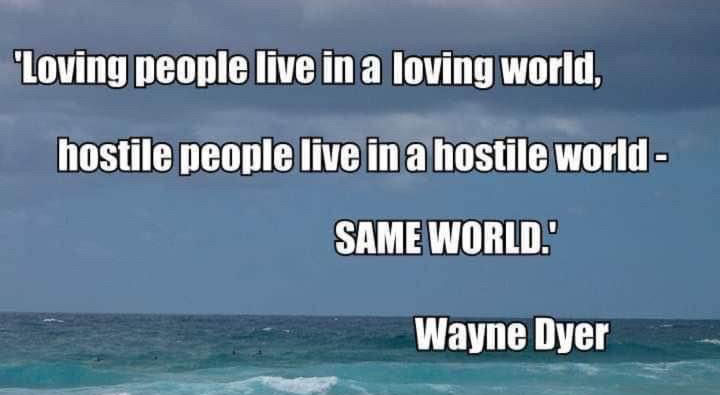
New Perspectives is an idea I got from one of my favourite thinkers, Wayne Dyer, who said:
"When we change the way we look at things, the things we look at change."
The secret, however, was to realize that the world's effect on our psychological, mental and emotional state is a product of our imagination, our perception of the world, and the stories we tell ourselves in our heads about how we ought to interpret it.
So, let's plunge into the various ways I found helpful in helping me see the world (and anything that happens to me) differently.
New Perspectives
Your death
There's a story of an elderly woman who got on a bus, in which a younger woman came to sit next to her at the next stop, and hitting her with her many bags. Upon not seeing the elderly woman complain, the young woman was intrigued and a tad confused, and so asked her why she hadn't griped about her rude behavior. The elderly woman's answer was "There is no need to be rude or discuss something so insignificant as our journey together is so short, because I'm gonna get off at the next stop."
Bingo! That is it, I thought. This is the rule of life. I began imagining life as a journey, like a train journey, except for the fact that none of us know when we or anyone else will be getting off. Anyone could leave this world at any moment. YOU could be living your last day as you're reading this.
Now, take a deep breath.
Feel that breath?
Good.
That breath could've been your last.
Any breath could be our last.
Any day could be our last.
Any interaction, conversation or connection we make with another person could be the last time we interact with that person. You just never know if this time will be the last time that that person hears your voice.
So be careful what you say to someone today because you may not have tomorrow to take it back.
But also remember that it's a two-way street. Have the courage to express your feelings and never hold anything back, because you may not have the chance to do so tomorrow.
Never take anyone or anything for granted.
Because remember, Tomorrow is promised to no one.
Everyone's dead
Imagine if, overnight, everyone died or somehow simply disappeared, and you awoke from your slumber after hitting the pillow in anger and frustration the night before.
You wake up and realise that everyone is gone. Your friends, your neighbors, your family, your siblings, your children, your parents, your grandparents, your spouse or partner, your political opponents, your admired idols, your favourite musicians, the people you didn't forgive, that guy who generously offered to pay for your meal at that restaurant while you were worried about being embarrassed in front of your date, your dearest childhood friend, your mentors, your teachers, your boss at work, the anchor you see on T.V. evening news, your favourite actors, all the people you ever dated, your old crush, the strangers you chose to help, that guy over downtown who upon seeing you wears a beatific smile, your overseas penpal, your cousins, relatives and entire in-law family, your co-workers, your colleagues, and everyone that ever was... Poof ! Gone !
Shockingly, they have vanished overnight as you were asleep. And you wake up in such an empty world. Would you be happy with the last thing you said to a loved one? Would you be glad with the last way you behaved with someone in your life? Would you be content with the last way you thought about them? Would you be thankful for how you chose to behave in utmost and unconditional kindness with them — or instead lamenting the last way you interacted with someone in your life?
The question that we perhaps have to ask ourselves all is:
What if we woke up tomorrow with only what we were grateful for today?
Or to put it differently, if you knew today was the last day of your life, what changes would you make to your attitude, perceptions and behavior?
Another most powerful question to ask is:
If this person dies tomorrow, what will I miss about them the most?
There's another way of thinking of it which is far less macabre, but potentially more effective at getting you to appreciate that person more. Although, that may depend on who that person is to you and how close you are etc..
Instead of imagining that this person — or everyone else — has died, imagine that that person has gotten Alzheimer's. Now I want you to imagine you're walking up to them, and holding their hand and asking them how they feel. Visualize it clearly and vividly in your head. Take as much time as you need to do this.
Now. Imagine that they respond by saying "I'm ok. I'm sorry, but ... who are you exactly? I... I do not remember us meeting before... What a kind soul you are to ask a stranger how they're feeling!"
Silence ensues...
You respond by trying to remind them of who you are to them, and what or how much you meant to them... but to no avail. They're gone. They can't remember a thing.
...
Now, how did that make you feel?
Yes. Notice it.
Feel it.
...
It boils down to asking ourselves simple yet powerful questions. Here are a few more examples:
• If today was the last day of my life, would I treat this person the way I'm about to treat them?
• Would I be saying what I'm about to say?
• If this is the last time I'll ever get to see and speak to this person, is this what I wish to be the last thing I say to them?
Again, tomorrow is promised to no one.
The trick here is to ask questions to yourself. Personally, I've learned that the quality of answers we get depends to a great extent on the kind of questions we choose to ask ourselves. So, try out new questions, different combinations, and see what works best for you. There is no straightforward formula, just try it out and decide which questions make you feel it on a deeper level.
That person is their 5-year-old self
Yes, you read that correctly.
Another technique I use and find quite potent is imagining that person as their 5-year-old self. This, I noticed, entices and engages my inner compassion and unconditional love for the other person.
When you think of it, as humans, we are much more likely to exhibit kindness, compassion, understanding and forgiveness towards a 5-year-old compared to an adult in a situation in which they both behave exactly the same, doing the same things and acting and speaking in the same way.
Granted, this technique is dependent on your idea and perception of how 5-year-olds should be treated. To wit, for example if you treat 5-year-olds ruthlessly or punitively, if you do not show actual 5-year-olds mercy, understanding or a kind, encouraging attitude, then, this technique is likely to backfire for you. So, take the time to ask yourself: How do I treat actual 5-year-olds? And is this how I want to continue treating them?
If you find that you still do not feel any pity, compassion or mercy for 5-year-olds when they blunder, then, skip this technique please.
But, as humans, we generally have an innate compassion and propensity for kind merciful understanding towards 5-year-olds. So, for most of us, seeing people as their 5-year-old self, regardless of their actual age, is a highly potent and simple trick one can employ to conduce a profound perceptual, and thus, a behavioral shift.
Which brings us to the next technique ...
That person is your child
Actually there are two versions of this technique, and both can be effective and powerful depending on your pre-existing view of the world.
But let's start with the main, obvious one:
Seeing the other person as their child-self may help induce feelings of loving compassion and even pity for them, but they're still somebody else's child. But what if, just out of curiosity, that person wasn't just any 5-year-old, what if they were your 5-year-old?
If that other person was your child, and someone else was treating them the same way you are about to treat them, how would that make you feel?
The trick here isn't just pretending as if that person was your child, it's in the make-believe notion that another person, ideally, a total stranger, is treating them the same way you're treating (or about to treat) them and you were just simply standing there witness it all unfold. I invite you to close your eyes and imagine how that would make you feel.
We all know that we can sometimes be cruel, unkind or harsh on our own children (or from how our parents would treat us, for example). Therefore, merely imagining that the other person is your child may not be enough — and just like the previous technique, it can potentially backfire.
The second way of thinking of it doesn't involve much imagining or pretend: this person is somebody else's child — which will invariably be the case unless they are indeed your child. You then ask yourself, "do I wish to treat somebody else's child the way I'm about to treat them?"
Remembering that we’re all somebody’s child allows us the necessary space to think with clarity and to see the other person for who they truly are: a human being. This evokes our compassion, arousing a sense of "No, I cannot bring myself to do this". We're all indeed just wounded children in adult bodies. None of us would ever wish to treat somebody’s child badly.
So, whether you choose to employ the first version or the second, whether the other person is your child, or indeed just another person's child — as they most likely are — you'll feel immense compassion arising within you that will empower you to act with clarity, manage your emotions better, and avoid behaviors you may later regret, thus improving your relationships overall.
Bonus point on this one: Try combining this act with the previous one, i.e. act and feel as if that the other person is your 5-year-old child being treated by some other stranger the exact same way you're treating them. Chances are, you'll immediately and immensely feel compassion, love and even sorrow towards this person.
Pale Blue Dot
This is probably one of the most potent of them all. The one to rule supreme.
Our existence on the Pale Blue Dot.
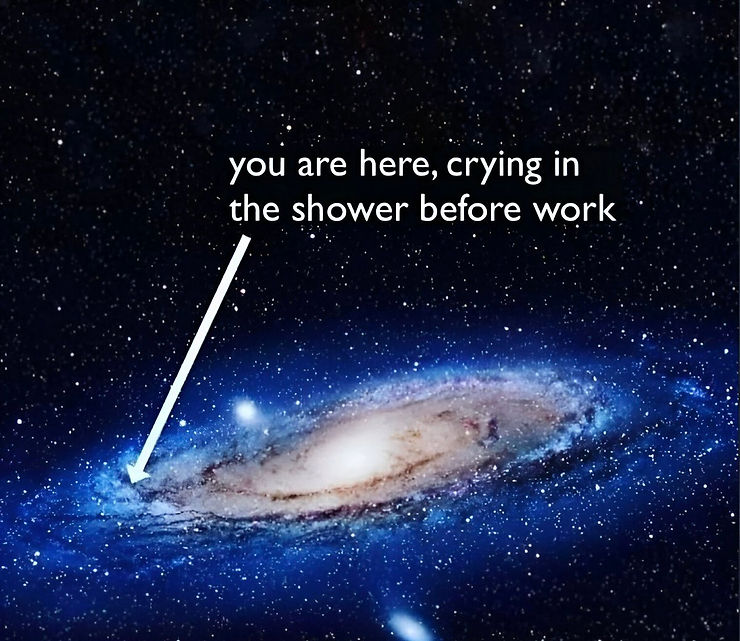
Remember Carl Sagan’s words that we're living together on this tiny world floating through space? Well, it truly is humbling to think about how truly small and insignificant we are in the grander scheme of things.
Did you know that the size of the Earth compared to the entire universe — not just the observable, but the entire hypothesized universe — is on the scale of 1/10 tredecillion? Which is 1 followed by FOURTY-THREE zeros. That number, for reference, looks like this:
10,000,000,000,000,000,000,000,000,000,000,000,000,000,000
So, the universe is 10 tredecillion times larger than the Earth, not any of us teeny tiny humans on it — and that's compared to the Earth based on radial measurements. Now, how big is any of us compared to the Earth, which would then compare to the Universe?
I think you get the idea. We're so tiny compared to everything, that darkening our lives with grudges, distrust, not forgiving others, hatred, jealousy, envy or whatever else negative feeling we let fester inside us doesn't make any sense! It is but a shameful waste of our brief, ephemeral journey on this Earth, because these negative feelings really don't matter in the grand scheme of things.
So the real question we have to ask is perhaps: Is holding pain, grudges and resentment really worth it? Will our grudges save us? Will blaming each other serve us? What's the point of any of them anyway?
When the ego sees how impossibly tiny each of us are, and how insignificant we are in the grand scheme of things, I notice that it tends to just shut up — literally my ego goes speechless. This is certainly, at least for me, one of the more powerful tactics I've ever used to tame my hitherto huge ego.
We are all mortals
This one is related to the previous ones, but it combines the fact that you as a person could die with the fact that all of us could be dead tomorrow too. It's effectively an amalgamation of the first two tactics I talked about; which is why it's so powerful.
The idea is simple: Remember that, one day, we're all gonna die anyway. And that that day, is totally unknown, spontaneous and could always knock on our door any moment. Again, tomorrow is promised to no one.
Death could always be around the corner. So, why not treat ourselves and each other with kindness, considering we could all disappear and lose it all at any moment on any given day?
Now, I found that all these techniques, especially if two or more are employed in conjunction with one another, are quite powerful indeed in helping me cultivate my inner peace and a perspective shift that allows me to zoom out of my nonsense and see the bigger picture. But I have to admit that, sometimes, these techniques may become depressing or put one on the wrong path if they're practiced too much or without self-awareness.
Particularly, the idea that we're all going to die anyway shouldn't mean that you could just do whatever the hell you desire and follow your innermost nastiest instincts, nor should the fact that we're all so impossibly insignificant in the grander scheme of things obviate the reason for having goals, adhering to a high moral code, or enjoying life and living everyday to the fullest. We're still here for a reason, and if we have others who value and cherish us, we'll feel far from insignificant.
But then again, just like anything really, all these notional facts come with an unintended side effect. That side effect is that while it may tame one's ego, it may also backfire and tame one's self-confidence and thus one's motivation and desire to live and pursue goals. So, how do you balance your need for self-confidence with your desire to tame your ego?
Well, the answer, it turned out, was a rather simple matter of fact: We're all equal.
Everyone's equal and awesome.
Think about it. What is the ego's main proposition? "I'm better than others", "I'm superior" and so on, right? The go wants to feel smart, right and superior to others. Well, the techniques above help neutralize it, but what about self-confidence? What does it entail?
It wants to feel that the person (i.e. you) is awesome.
I found that simply remembering the fact that "we're all gonna die anyway" may become a double-edged sword. It may remind us to treat each other kindly because no one knows when they're gonna leave this world and that life is too short. But it also serves as a great equalizer.
In other words, if we're all mortals, there is no use nor meaning in egoistical behaviour — a realisation which may help tame the ego. But also it works the other way around. If we're all mortals, that means that no one is better than you, and that you do not need to feel anxious, threatened, nervous or scared of or around anyone at all! Not even around anyone you're attracted to, like your crush, or anyone who is above you in the social or economic hierarchy, like your boss, father-in-law, or a job interviewer.
You can just be yourself by remembering that we're all just human and also that you are awesome — but so is everyone else.
One final point. You don't need to completely kill the ego — I haven't seen anybody succeed in doing it. The goal is not to remove the ego, but to make sure you're the one controlling it, instead of the other way around.
Bonus method:
Base your ego not on being right, smart, perfect, or anything of a fragile, fleeting or tenuous kind. But rather, base it on you being a learner, and having that identity. So that whenever you're proved wrong, embarrassed or make a mistake, your ego doesn't kick in and start shouting in your head and creating negative feelings in you. Base your ego on something not just resilient, but anti-fragile.